
UK’s Most Stolen Cars in 2025: Are You at Risk in 2026?
Table of Contents
- Why the UK’s Most Stolen Cars List Matters More Than Most Drivers Think
- UK Car Theft Trends in 2025: What Is Really Driving the Numbers
- Why Common, Keyless and Hybrid Cars Are Being Targeted
- The Most Stolen Cars in the UK Right Now
- How Cars Are Being Stolen in the UK in 2026
- Relay Theft, Signal Jamming and Key-Programming Attacks Explained
- How to Protect Your Car Without Wasting Money on Weak Security
- What to Do Immediately If Your Car or Keys Are Stolen
- Conclusion
- FAQs
This article ranks the most stolen cars in the UK using 2025 DVLA data, explains the theft methods being used right now, and shows you which security layers actually stop thieves, and which ones are only a starting point.
In 2025, the Toyota C-HR, a hybrid family SUV, became the most-stolen car variant in the UK by trim level. That is not a story about one car. It is a signal that thieves have completely changed their strategy. They are no longer just targeting the most common cars. They are targeting the most profitable ones.
If your car is on the UK’s most stolen cars list or has keyless entry, you are at a higher risk than you probably realise. And if you think a Faraday pouch and a steering wheel lock are enough to protect you, this article will show you why that thinking leaves your car seriously exposed.

Why the UK’s Most Stolen Cars List Matters More Than Most Drivers Think
Most drivers assume their car is not interesting to thieves. That assumption costs thousands of people every year.
Around 54,830 private cars were reported stolen in the UK in 2025, according to DVLA data analysed by What Car?. That is roughly 150 cars stolen every single day, or one every 10 minutes. The figure is down slightly from 2024 (*add the number), but it remains more than double the number stolen a decade ago.
The number that should concern you most is this: 68% of stolen vehicles are never recovered. If your car is taken, the odds are heavily against seeing it again.
Knowing which cars are targeted, and why, is the first step to not being on next year’s list.
UK Car Theft Trends in 2025: What Is Really Driving the Numbers
Car theft in the UK has more than doubled compared to a decade ago, even though the overall number dipped slightly in 2025 (What Car?, 2026). The total vehicle theft figure fell from 61,343 in 2024, but the reduction is misleading. The type of car being stolen is shifting rapidly, and the methods being used are becoming harder to stop with basic security measures.
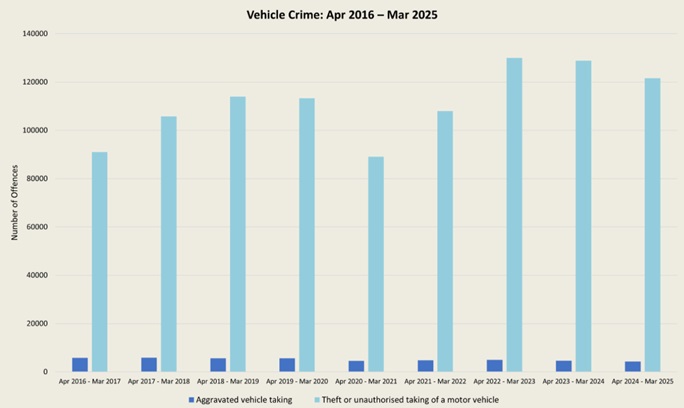
Source: Office for National Statistics, Crime in England and Wales: Appendix Tables, Table A5a: Police recorded crime by offence (Offence 48: Theft or unauthorised taking of a motor vehicle). Year ending June 2025 edition. Data covers England and Wales only. Published 23 October 2025. – ons.gov.uk – Crime in England and Wales: Appendix tables
The Metropolitan Police recorded 16,907 vehicle thefts in 2025 alone – around 46 cars every day in London (CheckCarDetails, 2025). Other high-theft areas include the West Midlands and Greater Manchester.
And the numbers only tell part of the story.
Why Common, Keyless and Hybrid Cars Are Being Targeted
Thieves target cars for one of three reasons: volume, value, or vulnerability.
Value
Value means the car or its parts fetch good money. Toyota hybrids and premium SUVs are now prime targets because catalytic converters, battery modules, and high-spec electronics command strong prices on the grey market. Toyota C-HR hybrid thefts rose 28% in 2025, and another C-HR trim saw a 39% jump (Carwow).
Vulnerability
Vulnerability means the car is easy to steal quickly and quietly. Keyless entry systems are now the main vulnerability. Between 60% and 70% of cars stolen in recent years were keyless models. Back in 2019, only 14% of cars were stolen this way.
The numbers we found on this are not what most drivers expect.
The Most Stolen Cars in the UK Right Now
The table below is based on DVLA data obtained through Freedom of Information requests, as analysed by What Car? and independently verified by QuestGates.
| Rank | Model | Key Detail |
|---|---|---|
| 1 | Ford Fiesta | 3,511, stolen in 2025. Most stolen for the second year running. Production ended in 2023, but ~1.4 million remain on UK roads. Thefts down 21% on 2024 but still more than double the next two models combined. Targeted almost entirely for parts. |
| 2 | Volkswagen Golf | 1,625. High demand for parts across all generations. The 2013-2020 (Mk7) accounts for just under half (49.9%) of all Golf thefts. Newer Mk8 models also vulnerable to relay attack. |
| 3 | Ford Focus | 1,474 stolen. Fourth-generation Focus (2011-2018) accounts for 56% of all Focus thefts. The 2019 on model has improved security, but 334 were still taken, representing 23% of all Focus thefts. |
| 4 | Toyota RAV4 | 1,348 stolen. The 2019-2025 model accounts for 94.6% of RAV4 thefts. Targeted for catalytic converters, hybrid battery modules, and high-value electronic components. Hybrid target |
| 5 | BMW 3 Series | 1,249 stolen. The 2019 on model accounts for 83% of all 3 Series thefts, with the plug-in hybrid variant the most sought-after. Premium resale value for parts and strong organised crime interest. |
| 6 | Nissan Juke | 1,200 stolen. A notable new entry into the top 10 in 2025. One of the UK’s best-selling compact SUVs, making it a high-volume target. Keyless entry vulnerability is a contributing factor in most thefts. |
| 7 | Toyota C-HR | 967 stolen. The biggest mover in the 2025 rankings. Hybrid variants saw thefts rise 28-39% year on year. Almost all thefts (97%) were of the first generation 2016-2023 model. Toyota’s second-generation Digital Key appears to be effective, only 3% of thefts involved the 2024-on model. Hybrid target |
| 8 | Lexus NX | 951 stolen. Significant increase in 2024 figures. Thefts split almost evenly between the 2014-2021 and 2022-on models (49.6% vs 50.4%). Closely linked to organised demand for Toyota/Lexus hybrid drivetrain components. Hybrid target |
| 9 | Land Rover Range Rover Evoque | 895 stolen. Down 18% on 2024, itself 35% down on the previous year, a sustained improvement driven by JLR security investment. 83% of thefts are of the first generation 2011-2018 model. JLR is retrofitting sleeping-key fob batteries and security software to older vehicles. Falling |
| 10 | Vauxhall Corsa | 874 stolen. Consistently one of the UK’s highest-selling cars, with ~36,000 new examples sold in 2025 alone and a large used-car supply. The fourth-generation 2006-2014 Corsa accounts for nearly 40% of all Corsa thefts. |
Source: DVLA Freedom of Information data, analysed by What Car? (February 2026) and independently verified by QuestGates (February 2026). Figures cover 1 January – 31 December 2025, England and Wales.
Philip Swift, Technical Director for Motor at QuestGates noted: “The most stolen models are all best-sellers, on average around eight years old, indicating that they are being targeted for parts.” This matters, thieves are often not after your whole car. They want what is under the bonnet or inside the trim.
How Cars Are Being Stolen in the UK in 2026
This is where the modern picture of car theft changes completely. Most people imagine it involves smashing a window or hot-wiring an engine. That picture is now decades out of date.
According to an analysis of ONS Crime Survey for England and Wales data by legal firm nm RTA Law, signal manipulation – the collective term for relay attacks, key cloning and signal jamming, accounted for 58% of all vehicle thefts in the year April 2023 to March 2024 (Regit, 2025). That figure was just 13% in the year April 2018 to March 2019, a fourfold increase in five years (Driving Instructors Association, 2025).
Old-fashioned physical break-in methods – smashing windows, forcing locks – now account for a small fraction of thefts and have been declining consistently for over a decade, according to ONS CSEW entry method data.
The shift is electronic, fast, and quiet. A car stolen by a relay attack leaves no broken glass, no forced door, no trace at all until you walk outside and find an empty space.
Relay Theft, Signal Jamming and Key-Programming Attacks Explained
Relay Theft
- One thief stands near your front door holding a device that captures your key fob’s signal, even through walls, from up to 100 metres away.
- That signal is instantly relayed to a second device held next to your car.
- The car thinks the key is present, unlocks, and starts.
- The whole process takes under 60 seconds.
- Your key never leaves your house.
Signal Jamming
- The thief blocks the signal from your key fob when you press the lock.
- The car does not actually lock, but you walk away believing it did.
- They then open the car without needing any key at all.
CAN Bus Injection
Thieves access the car’s diagnostic port, usually by removing a headlight to reach the wiring and program a blank key directly to the vehicle’s immobiliser.
This is increasingly used on premium vehicles that have hardened relay attacks.
The tools used to carry out these attacks are expensive. Some relay devices sell for over £20,000. But organised gangs treat them as business assets, sharing and renting them between groups.
In February 2025, the UK Government confirmed legislation making it illegal to possess or distribute electronic vehicle theft devices, with a maximum sentence of five years. But the law targets the supply of the tools. It does not harden your individual car’s security.
How to Protect Your Car Without Wasting Money on Weak Security
Here is where most security advice gets it wrong. Faraday pouches and steering wheel locks are widely recommended, and they are worth using, but they are not your main line of defence. They are supporting measures.
Think of car security as a 2 layer system.
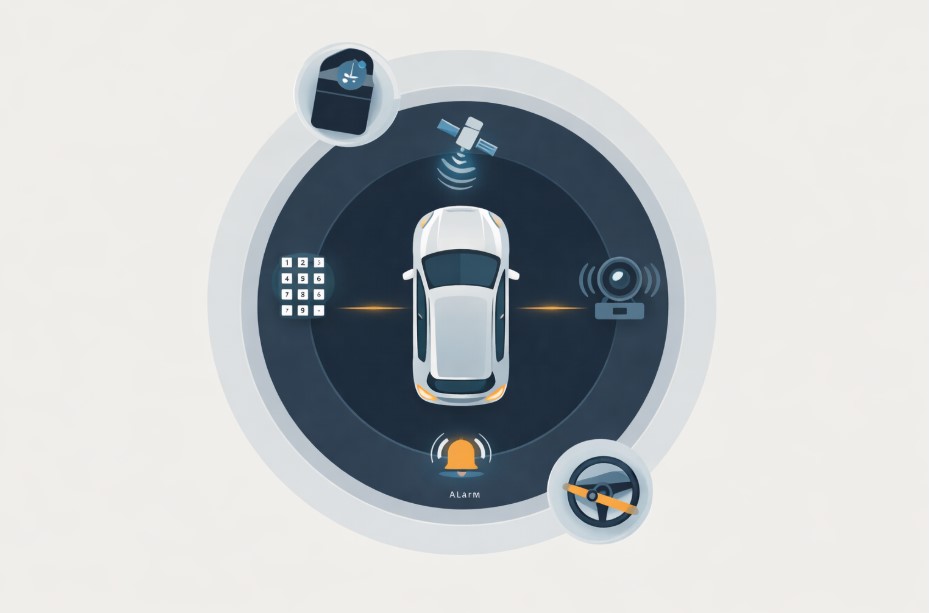
- The core layer prevents thieves from starting and moving your car, even if they manage to get inside.
- The supporting layer adds visible deterrence and signal protection.
You need both. Relying only on the supporting layer is like putting a warning sign on a fence with no barrier behind it.
Layer 1: The Core Defences That Stop Thieves Before They Start
These are the installations that professional thieves genuinely struggle to defeat. They do not just deter, they block.
Ghost Immobiliser
A ghost immobiliser works by requiring a unique PIN code entered through your car’s existing dashboard buttons before the engine will start. There are no visible components. No external wires. No aftermarket fob. Even if a thief successfully relays your key signal, clones your key, or programs a new blank key via the OBD port, they still cannot start the car without the PIN. It defeats relay theft, CAN bus injection, and key programming attacks in a single measure.
A ghost immobiliser must be fitted by a qualified installer to work correctly and to be valid for insurance purposes.

Thatcham-Approved GPS Tracker (S5 or S7)
A tracker will not prevent a theft attempt, but it transforms the outcome if your car is taken. Police prioritise vehicles with active tracking. Recovery rates are significantly higher when a vehicle is tracked in real time. For higher-risk vehicles, many insurers require a Thatcham S5 tracker as a policy condition.
The S5 category includes Automatic Driver Recognition – it detects unauthorised movement and alerts a 24/7 monitoring centre, which then coordinates with police.
UK insurers typically reduce premiums by 10-20% for Thatcham-approved systems.
Upgraded Alarm System
A factory-fitted alarm is the baseline. Professional thieves know exactly how to disable or ignore factory alarms.
An aftermarket alarm with motion sensors, anti-grab protection, and independent backup power is a different proposition. It alerts you if someone is near the car, triggers a visible and audible warning, and continues to work even if the factory system has been neutralised.
Combined with a ghost immobiliser, it creates a deterrent at multiple points of attack.
Dashcam with Parking Mode
A dashcam with parking mode and motion-activated recording does 2 things.
- It captures evidence of a theft attempt in progress, useful for police and insurance claims.
- And it signals to anyone approaching that they are being recorded.
Many organised theft groups scout vehicles before returning to steal them. Visible recording equipment changes the risk calculation.
Car Keys Solutions installs ghost immobilisers, Thatcham-approved GPS trackers, alarm upgrades, and dashcams across our UK locations. If your car is on the most-stolen list or has keyless entry, this is the right time to act.
Contact Car Keys Solutions to book a security fitting
Layer 2: Supporting Measures That Add Visible Deterrence
These measures are worth using alongside your core security. They add friction, reduce the chance of opportunistic theft, and support the first layer. But on their own, they are not enough against organised theft.
Faraday Pouches
A Faraday pouch blocks the radio signal from your key fob. No signal means no relay attack when your keys are inside it at home.
Look for products tested by Sold Secure or Secured by Design, and test your pouch every few months, as wear can create gaps.
Keep keys in an interior room, away from exterior walls and doors. However, a Faraday pouch only protects you when the fob is inside it. It does not protect your car in a car park, at work, or anywhere you carry your keys. It is one piece of a wider system, not a complete solution.
Steering Wheel Locks
A bright, heavy duty steering wheel lock tells an opportunist thief this car will take time and noise to move. Even if they bypass your keyless entry, driving the car away becomes much harder. Thieves operating quickly will look for a simpler target. Use it. Just do not rely on it alone.

Tactical Parking
ONS data shows that 38% of all vehicle thefts occur in semi-private areas such as driveways or residential car parks.
Park nose-in against a wall or garage door where possible, this blocks access to the front bumper and wheel arches that thieves target to reach OBD ports through headlight cavities.
| Security Measure | Cost Range | Stops Relay? | Stops OBD/CAN? | Deterrent? |
|---|---|---|---|---|
| Ghost immobiliser | From £499+ fitted | Yes | Yes | No |
| Thatcham S5 GPS tracker | From £499+ fitted | No | No | No |
| Upgraded alarm | From £950+ fitted | Partial | No | Yes |
| Dashcam (parking mode) | From £299+ fitted | No | No | Yes |
What to Do Immediately If Your Car or Keys Are Stolen
Time is critical in both situations. Here is the correct order of actions.
If your car is stolen:
- Call 999 if you witness the theft in progress. Call 101 if you discover it afterwards. Give the police the make, model, colour, and registration. They will issue a crime reference number – you need this for your insurance claim.
- If your car has a GPS tracker, contact the tracking company immediately to activate recovery.
- Contact your insurer with the crime reference number. Comprehensive cover includes theft, but you must have reported it to the police first.
- Notify the DVLA that your vehicle has been stolen.
If your car keys are stolen (but the car is not yet taken):
Report it to the police immediately and get a crime reference number.
- Call an automotive locksmith right away. A qualified locksmith plugs a diagnostic tool into your car’s OBD port and erases all programmed keys from the vehicle’s ECU, including the stolen ones. The stolen key becomes permanently invalid. New keys are then programmed in their place.
- Contact your insurer. Many comprehensive policies include stolen-key replacement, but you need a police report to claim it.
- If your house keys were also taken, contact your home insurer and arrange for a locksmith to change your door locks.
- Do not assume a spare key means the stolen key is safe to ignore. The stolen key is still paired to your car’s system until an engineer actively removes it. Your vehicle remains at risk until that is done.
Car Keys Solutions provides emergency car key deprogramming and replacement across our UK locations. If your keys have been stolen, contact us now to get the stolen key invalidated and a new key programmed today.
Contact us
Conclusion
The most stolen cars in the UK list for 2025 tells two clear stories. Volume cars like the Fiesta are targeted because they are everywhere. Hybrid SUVs like the Toyota C-HR are targeted because their parts are highly valuable. And nearly any car with keyless entry is vulnerable to relay attacks happening silently outside front doors across the country.
The good news is that most car thieves take the path of least resistance. Layering your security, ghost immobiliser, Thatcham-approved GPS tracker, upgraded alarm, and dashcam as your core, supported by a Faraday pouch and steering wheel lock, makes your car a genuinely hard target. Professionals move on. Opportunists move on. Your car stays where you parked it.
If your car is on this list, has keyless entry, or is a hybrid, the time to act is now, not after you lose it.
Car Keys Solutions installs ghost immobilisers, Thatcham-approved GPS trackers, upgraded alarms, and dashcams across our UK locations. We also provide mobile and workshop car key replacement, emergency key deprogramming, and key programming services. Contact us to book a security fitting or key service.
Contact Car Keys Solutions
FAQs
What is the most stolen car in the UK right now?
The Ford Fiesta is the most stolen car in the UK as of 2025, with 3,511 examples reported stolen during the year, according to DVLA data. That is more than double the combined total of the second and third most-stolen models. Despite production ending in 2023, around 1.4 million Fiestas remain on UK roads, making them a high-volume target for parts thieves. The Volkswagen Golf and Ford Focus are second and third.
Why are hybrids and keyless cars being targeted more in 2025 and 2026?
Hybrid cars are targeted because components – particularly catalytic converters and battery modules – fetch strong prices on the grey market. Toyota C-HR hybrid thefts rose 28% in 2025 alone. Keyless cars are targeted because relay attacks allow thieves to unlock and start them in under 60 seconds without ever touching the keys. Between 60% and 70% of modern car thefts now involve keyless entry exploitation.
How can I stop relay theft on a keyless car?
The most effective defence against relay theft is a ghost immobiliser. Even if thieves successfully relay your key signal and enter the car, they cannot start the engine without your PIN code. As a supporting measure, store your key fob in a Faraday pouch when at home – this blocks the fob’s signal and makes the initial relay capture impossible. However, a Faraday pouch only works when the fob is inside it. A ghost immobiliser protects your car everywhere.
If my car keys are stolen, do I need to change the locks or reprogram the car?
You do not always need new physical locks, but you must have the stolen key removed from your car’s ECU urgently. An automotive locksmith uses a diagnostic tool to erase the stolen key from the vehicle’s immobiliser system, making it permanently inactive. New keys are then programmed in their place. Physical lock changes are more expensive and only needed in specific circumstances. The faster you act, the lower your risk.
Is it cheaper to get a replacement car key from a locksmith or the dealer?
An automotive locksmith is almost always cheaper and faster than a dealership for most key types. Dealerships typically charge £250 to £600 for a modern key, while a qualified auto locksmith usually charges £100 to £250 for the same job with the added convenience of coming to you. For most mainstream cars: Ford, Vauxhall, Toyota, VW, a locksmith cuts and programs the key on the spot. Some high-end models with manufacturer restricted systems may still need dealer involvement.
Do steering wheel locks and Faraday pouches actually work?
Both are useful, but neither is sufficient as your main protection. A Faraday pouch blocks relay attacks when your keys are stored inside it at home. A steering wheel lock discourages opportunist thieves who want a quick, quiet job. Against organised professional thieves using relay devices, OBD tools, and CAN bus equipment, these measures create friction but do not stop a determined attack. That is why a ghost immobiliser, GPS tracker, upgraded alarm, and dashcam form the core layer, they are what professionals genuinely struggle to defeat.
What percentage of stolen cars are recovered in the UK?
Approximately 44.9% of stolen cars in the UK were recovered in 2025, up from 42.5% in 2024, according to QuestGates analysis of DVLA data. The average time from theft to recovery fell from 27.1 days to 25.6 days. Vehicles with active GPS tracking have significantly higher recovery rates. Joint operations between police and tracker companies uncovered 55 illegal chop shops in a single operation in 2025.
Which UK areas have the highest rates of car theft?
London has the highest vehicle theft concentration. The Metropolitan Police recorded 16,907 vehicle thefts in 2025, around 46 cars stolen every day in the capital. Other high-risk areas include Doncaster (11.7 thefts per 1,000 people, 218% of the national rate), Outer London, and Birmingham. The West Midlands and Greater Manchester also report high levels of theft.
Share
