
Best 5 Immobilisers for Cars and Vans in 2025
Ghost Pro, Ghost III PRO FD, CAN Phantom, and StarLine M13 side by side: how each one stops a thief, which vehicles it suits, and what it costs to fit in 2026.
For most modern cars and vans, the best immobiliser in 2026 is a CAN bus ghost immobiliser, which blocks the engine until a code is entered on the vehicle’s own buttons. The Ghost Pro suits newer vehicles and the Ghost-II older ones. The CAN Phantom and Scorpion X-Series work in a similar way. None of them is Thatcham approved, because Thatcham does not approve this type of immobiliser (Carwow, 2025).
Table of Contents
- Why aren’t ghost immobilisers Thatcham approved?
- The 5 immobilisers compared
- Is your car or van a target?
- How much does it cost to fit an immobiliser in 2026?
- Do you need an immobiliser, a tracker or both?
- Frequently Asked Questions
- Conclusion
Why aren’t ghost immobilisers Thatcham approved?
Thatcham Research rates vehicle security for the insurance industry, but its scheme was never built for ghost immobilisers. Its categories cover alarm and immobiliser systems (Categories 1 and 2), mechanical locks (Category 3), locking wheel nuts (Category 4) and trackers (S5 and S7). Anything outside the scheme is classed as Q class (RAC, 2025). So if you see a ghost immobiliser listed as “Thatcham S5”, the label is wrong. S5 is a tracker rating.
Every car made since 1998 already has a factory immobiliser (RAC, 2025). The trouble is that it only checks for the key. Thieves who relay your key’s signal or clone it can convince the car the right key is present. A ghost immobiliser asks for something the key cannot give: a sequence entered on the car’s own buttons. It sends out no signal of its own, so there is nothing for a thief to detect or copy (Carwow, 2025).
You can read more in our guide to what Thatcham is and how it affects vehicle security.
The 5 immobilisers compared
Autowatch Ghost-III
Best for: recent cars and vans, especially models built on CAN-FD networks.
The Ghost-III is Autowatch’s newest immobiliser and the replacement for the Ghost-II. It is built specifically for CAN-FD, the faster data network that BMW, Mercedes-Benz and Audi increasingly use, and it can work across two CAN networks at once (Autowatch, n.d.b).
Once fitted, it sits invisibly on the vehicle network and blocks the engine using a mix of CAN, LIN and analogue immobilisation, matched to each vehicle’s wiring. Because it works through the vehicle’s data rather than simply cutting power, factory remote heating and cooling through apps such as JLR InControl and the Ford App can still work on supported models. Autowatch notes that some vehicles may lose remote climate or remote movement functions.
There are three ways to disarm it, depending on the installation: a code entered on the steering wheel or dashboard buttons, a discreet key-tag, or a smartphone. A service or valet mode lets a garage drive the vehicle without your code, and the system re-arms itself afterwards without shutting the car down.
The Ghost-III must be fitted by an Autowatch-trained technician, and compatibility is checked against Autowatch’s vehicle list before installation.
Autowatch Ghost Pro (Ghost-II)

Best for: cars and vans a few years old, built on standard CAN networks.
Ghost Pro is the name Autowatch uses alongside the Ghost-II. Its own operating guide covers the “Ghost-II/Ghost Pro immobiliser system” as one product (Autowatch, n.d.c). It works over a single CAN network and does not support CAN-FD, which is why Autowatch is phasing it out in favour of the Ghost-III (Autowatch, n.d.a).
The driver disarms it with a personal sequence of 4 to 20 presses on the vehicle’s standard buttons, such as the steering wheel controls or window switches. The indicator light flashes twice to confirm. A paired smartphone, running the Autowatch Ghost-II app over Bluetooth, or a key-fob can also disarm it automatically when the ignition is switched on.
Service mode allows the vehicle to be handed to a garage without the owner’s code being shared. It is activated by pressing the service button five times and exits automatically once the vehicle has been driven at 32 mph or more for over 15 minutes.
If the sequence is forgotten, a four-digit emergency code printed on the Ghost card is entered using the accelerator while the brake is held. This unlocks the system so the vehicle can be driven or a new code set.
Autowatch Ghost III PRO FD: Advanced CAN-FD Immobiliser
The Autowatch Ghost III PRO FD is a next-generation vehicle immobiliser designed to protect against key cloning, relay attacks and unauthorised vehicle operation. Featuring high-speed CAN-FD technology, it supports newer vehicle electronic systems while maintaining compatibility with traditional CAN networks.
Key features include:
- CAN-FD Technology: Supports modern high-speed vehicle communication networks and dual CAN integration.
- Personalised PIN: Requires a unique disarm sequence entered through existing vehicle buttons.
- Multiple Authorisation Methods: Supports PIN, key-tag or smartphone authentication, depending on installation.
- Advanced Engine Immobilisation: Blocks unauthorised driving through CAN/LIN communication or conventional circuit immobilisation.
- Discreet Installation: Integrates with vehicle electronics without visible indicators revealing its location.
- Service/Valet Mode: Allows temporary vehicle use without sharing the owner’s PIN.
- Smart Immobilisation: Preserves compatible factory remote heating and cooling functions.
- TASSA Verification: Listed among TASSA’s verified vehicle security products.
CAN Phantom
Best for: drivers who want a UK-designed system.
CAN Phantom is the main alternative to the Autowatch Ghost range. It works on the same principle, sitting on the vehicle’s CAN network and blocking the engine until the correct code is entered. Like other ghost-style systems, it sends out no radio signal and cannot be found by plugging a scanner into the vehicle’s diagnostic port (Carwow, 2025).
The key differences are origin and handover. CAN Phantom is designed and manufactured in the UK, while the Autowatch Ghost is a South African system. CAN Phantom’s Valet and Maintenance mode is controlled through a web app, so a garage can work on the vehicle without the owner’s code being shared (Carwow, 2025).
CAN Phantom is not Thatcham approved, which is true of every ghost-style immobiliser. The choice between it and an Autowatch Ghost comes down to which system supports the vehicle and which features the owner will use.
StarLine M13
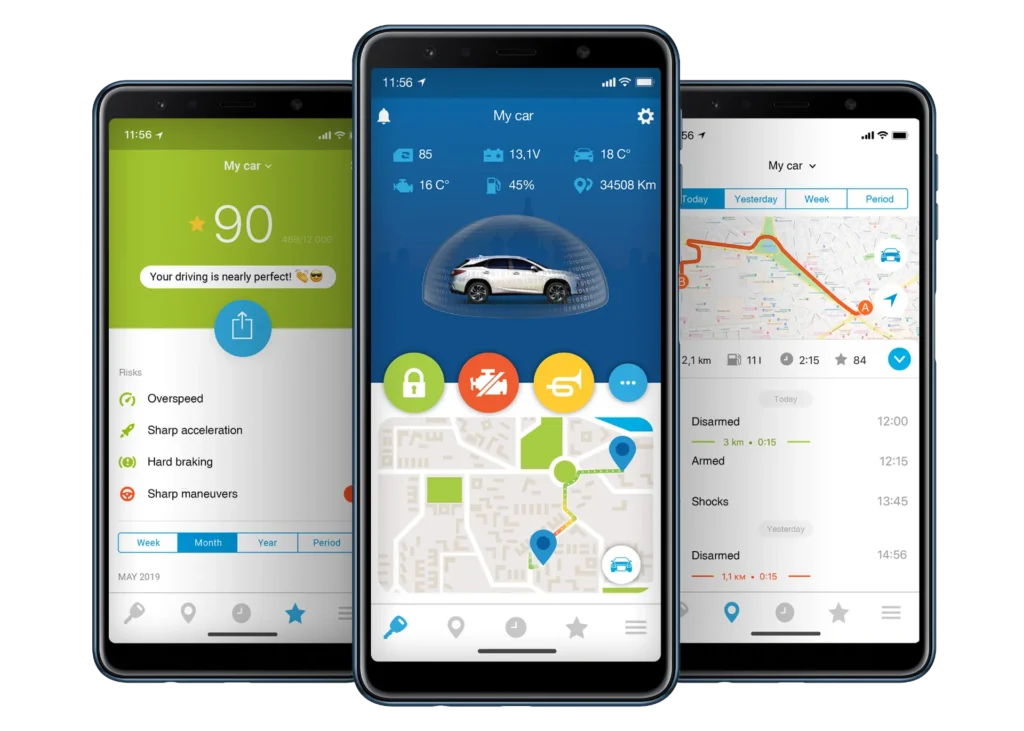
Best for: owners who want live tracking with no subscription.
StarLine M13 universal tracker offers an easy and economy vehicle positioning, live tracking and basic anti-theft security features. Device can send text message with exact position and link to online map. It can be quickly mounted in any road vehicles, motorcycles, quad bikes, boats and electric scooters. Controlled object can be real time monitored on desktop at subscription free starline.online web service and StarLine 2 free mobile app.
Major benefits:
• Universal input power for various means of transport
• Quick installation • Rugged waterproof housing
• Lifetime free subscription tracking
• Geofence In / Out alert
• Tamper alert (shock sensor)
• Black box coordinates memory
• Remote engine cut
The trade-off is timing. A ghost immobiliser stops the vehicle before it moves, while the M13 acts only once the owner knows the vehicle is being taken. It carries no Thatcham rating, so it does not meet an insurer’s requirement for an S5 or S7 tracker. Paired with a ghost immobiliser, it covers both prevention and recovery.
Is your car or van a target?
Vehicle theft is falling, but slowly. DVLA figures analysed by QuestGates show 90,625 vehicles were stolen in the UK in 2025, down 11.36% on the year before. That is still close to 250 a day. Ford, BMW and Toyota were the makes thieves took most often, and only 44.94% of stolen vehicles were recovered (QuestGates, 2026).
Vans tell a similar story. Van thefts fell 16% to 10,013 in 2025, or roughly one every 52 minutes. Ford dominates the list. Across 2024 and 2025, 11,709 Ford vans were stolen, and the Transit 350 was the most stolen single model with 1,309 thefts (Insurance Edge, 2026).
| Most stolen van makes, 2024-2025 | Thefts |
| Ford | 11,709 |
| Mercedes-Benz | 2,935 |
| Peugeot | 1,585 |
| Vauxhall | 1,512 |
| Citroën | 1,423 |
Source: DVLA data via Tempcover (Insurance Edge, 2026)
For more on how keyless thieves operate, see our guides to securing your keyless car from relay attacks and CAN injection car theft.
How much does it cost to fit an immobiliser in 2026?
At Car Keys Solutions, immobiliser fitting starts from £499 at our workshops and £550 for mobile fitting at your home or workplace. The final price depends on the product and the vehicle. Newer models with CAN-FD networks take longer to fit, and adding a tracker or alarm on the same visit saves paying for labour twice.
Do you need an immobiliser, a tracker or both?
Each device does a different job. An immobiliser stops the vehicle being driven away. A tracker helps you get it back. An alarm tells you something is happening right now. We cover this in more depth in the difference between an immobiliser and a car alarm.
A ghost immobiliser on its own closes the gap that relay and cloning thieves rely on. A tracker matters most when the vehicle or what is inside it is expensive to replace, because fewer than half of stolen vehicles are ever recovered. For a van carrying tools, pair the immobiliser with a Thatcham S5 or S7 tracker. See our vehicle tracking installation page and car alarm fitting options.
Steering wheel locks and Faraday pouches are useful extras. They make a thief’s job slower, but they do not replace an immobiliser.
| Professional fitting across London and the South East. Car Keys Solutions fits ghost immobilisers, Thatcham-approved trackers, alarms and dashcams at our workshops in East Finchley, South Norwood, Watford and Brentwood, or at your home or workplace. Contact us for a fixed quote. |
Frequently Asked Questions
Is a ghost immobiliser worth it in 2026?
For most keyless cars and vans, yes. A ghost immobiliser blocks the engine until a code is entered on the vehicle’s own buttons, so a relayed or cloned key is not enough to drive away (Carwow, 2025). The risk remains real. 90,625 vehicles were stolen in the UK in 2025, and only 44.94% were recovered (QuestGates, 2026). For a vehicle that is never recovered, the owner is left relying entirely on an insurance payout.
Can a ghost immobiliser stop keyless relay theft?
It stops the drive-away stage. Relay and cloning attacks trick the vehicle into believing the genuine key is present, which is enough to unlock and start most keyless cars. A ghost immobiliser adds a second check that the key cannot pass: a personal code entered on the steering wheel, dashboard or door buttons. Without that code, the engine stays blocked, even with the real key inside the cabin and the doors already open (Carwow, 2025).
Can thieves detect a ghost immobiliser?
Not by the usual methods. A ghost immobiliser has no key fob signal to intercept, because it uses the vehicle’s own buttons and is wired into its existing network. It cannot be picked up by radio scanners or by plugging diagnostic equipment into the vehicle’s OBD port (Carwow, 2025). From the outside, a thief has no reliable way of knowing one is fitted, or which buttons make up the code.
Will a ghost immobiliser lower car insurance?
It can, but it is not guaranteed. Some insurers reduce premiums when an aftermarket immobiliser is fitted, while others make no change, so the result depends on the insurer and the policy (Carwow, 2025). Ghost immobilisers carry no Thatcham category, because Thatcham’s scheme only covers alarms, standard immobilisers, mechanical locks and trackers (RAC, 2025). The safest approach is to check with the insurer before fitting and declare the immobiliser once it is installed.
What happens if the ghost immobiliser code is forgotten?
The vehicle can still be started. Autowatch Ghost systems come with a four-digit emergency code printed on the card supplied at installation. The code is entered using the accelerator pedal while the brake is held. Once accepted, the system unlocks, so the vehicle can be driven straight away or a new personal code can be set (Autowatch, n.d.c). The card should be stored safely at home, never inside the vehicle, where a thief could find it during a break-in.
Can a garage service a vehicle with a ghost immobiliser fitted?
Yes. Ghost immobilisers have a service or valet mode, so the owner does not need to share the code with a garage, valet or car wash. On the Ghost-II and Ghost Pro, service mode is switched on by pressing the service button five times, and it exits automatically once the vehicle has been driven above 32 mph for more than 15 minutes (Autowatch, n.d.c). On the CAN Phantom, the equivalent mode is controlled through a web app (Carwow, 2025).
What is the best immobiliser for a Ford Transit?
A ghost immobiliser that supports the Transit’s year and model is the strongest starting point, ideally paired with a Thatcham S5 or S7 tracker to help with recovery. Ford is the most stolen van make in the UK, with 11,709 Ford vans stolen across 2024 and 2025. The Transit 350 was the single most stolen van model over the same two years, with 1,309 thefts (Insurance Edge, 2026). Compatibility should always be confirmed before fitting.
Which cars are most likely to be stolen in the UK?
Ford, BMW and Toyota were the most stolen car makes in the UK in 2025, according to DVLA data analysed by QuestGates. Overall, 90,625 vehicles were stolen during the year, down 11.36% on 2024, and only 44.94% were recovered (QuestGates, 2026). Theft is falling, but the numbers remain high, at close to 250 vehicles a day. Owners of these makes, particularly keyless models, face the greatest risk and gain the most from an aftermarket immobiliser.